

From Story to Play: The Play Schema Guide
Everything from the Play Schemas series, including a full picture book booklist, playful invitations, and practical support gathered into one resource.
A couple months ago, I shared a three-part series exploring play schemas — something that completely changed the way I see my kids play.
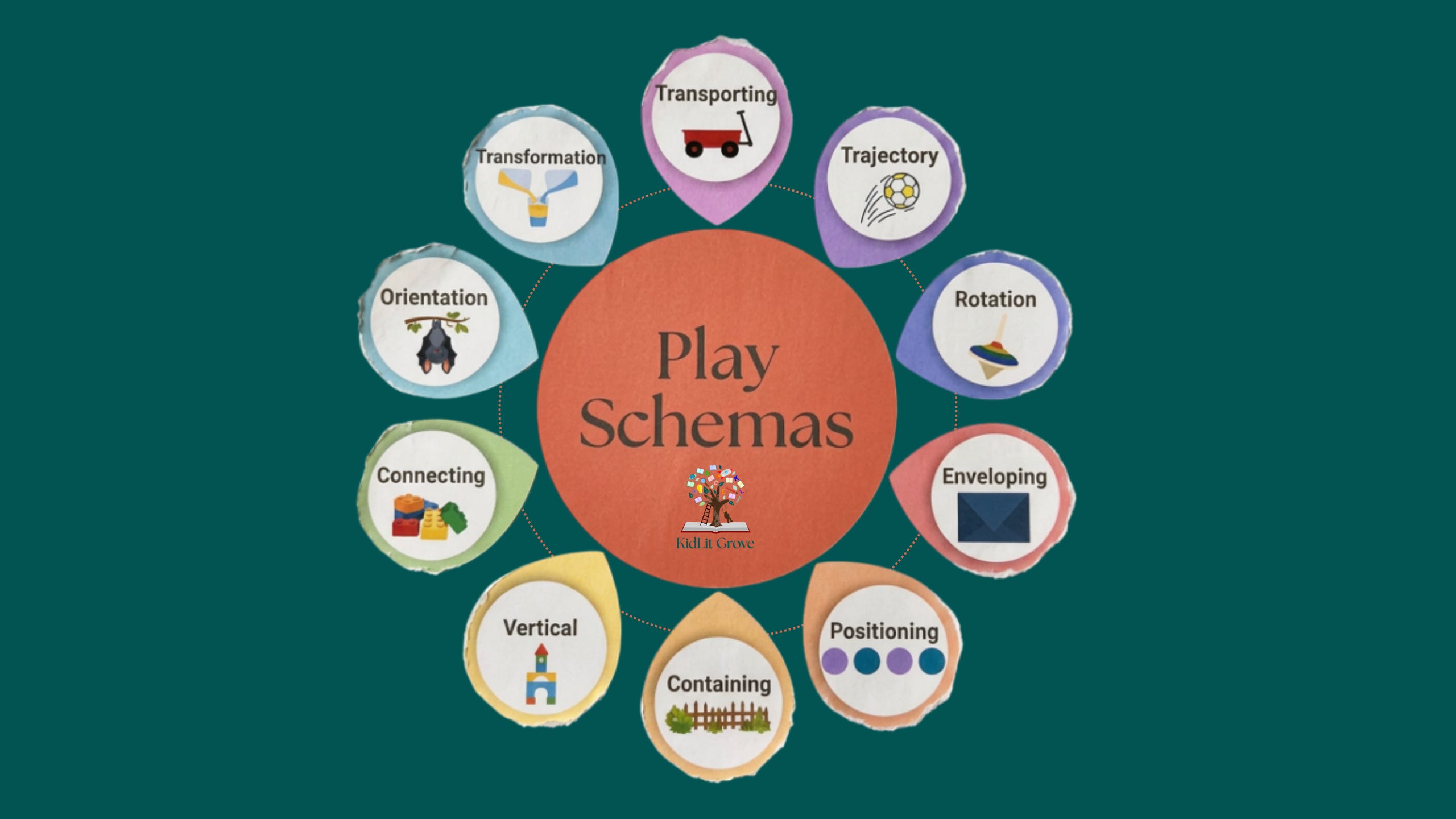
We began by looking at some of the more obvious (or you might say louder) play patterns…like dumping every basket filled with toys, dropping objects from the highchair to watch them fall, launching toys across the room, or spinning in endless circles.

Then we moved into some of the quieter schemas…like the kiddo who paints their hands instead of paper, builds fences around toy animals, collects treasures in their pockets, or lines toy cars up with precision.

Finally, we explored the builders, climbers, and creators… the kids who stack towering towers, connect loose parts in new ways, transform things into another through imaginative play (anyone have a mud kitchen?), and love seeing the world from a different perspective.

Throughout this series and beyond, I’ve found myself noticing play in an entirely new way.
My youngest spent what felt like forever in a “dumping phase.” Every basket of toys ended up upside down across the living room floor. Like many parents, my first instinct was to wonder how I could make it stop.
But after diving into these play schemas a little more, I began to notice he was exploring concepts like cause and effect, gravity and volume, and discovering what happens when objects fall and scatter.
It changed the way I respond to messy play.
There are schemas everywhere. They’re in the brown playdough after all the colors are combined into one giant lump; in the child hanging upside down from a climbing dome; even in the elaborate blanket forts that take over the living room.
All of it shows how children make sense of their world in the way they know best: through play.
Play Schema Guide
I’ve combined the content from these posts into one resource you can reference whenever you notice a new play pattern emerging.
It’s designed to help you better understand what children are exploring through play and offer simple ways to support those interests through a variety of springboards for child-led play.
Each invitation is intentionally paired with picture books and open-ended activities with simple materials so you can extend the play without needing fancy supplies or expensive toys.
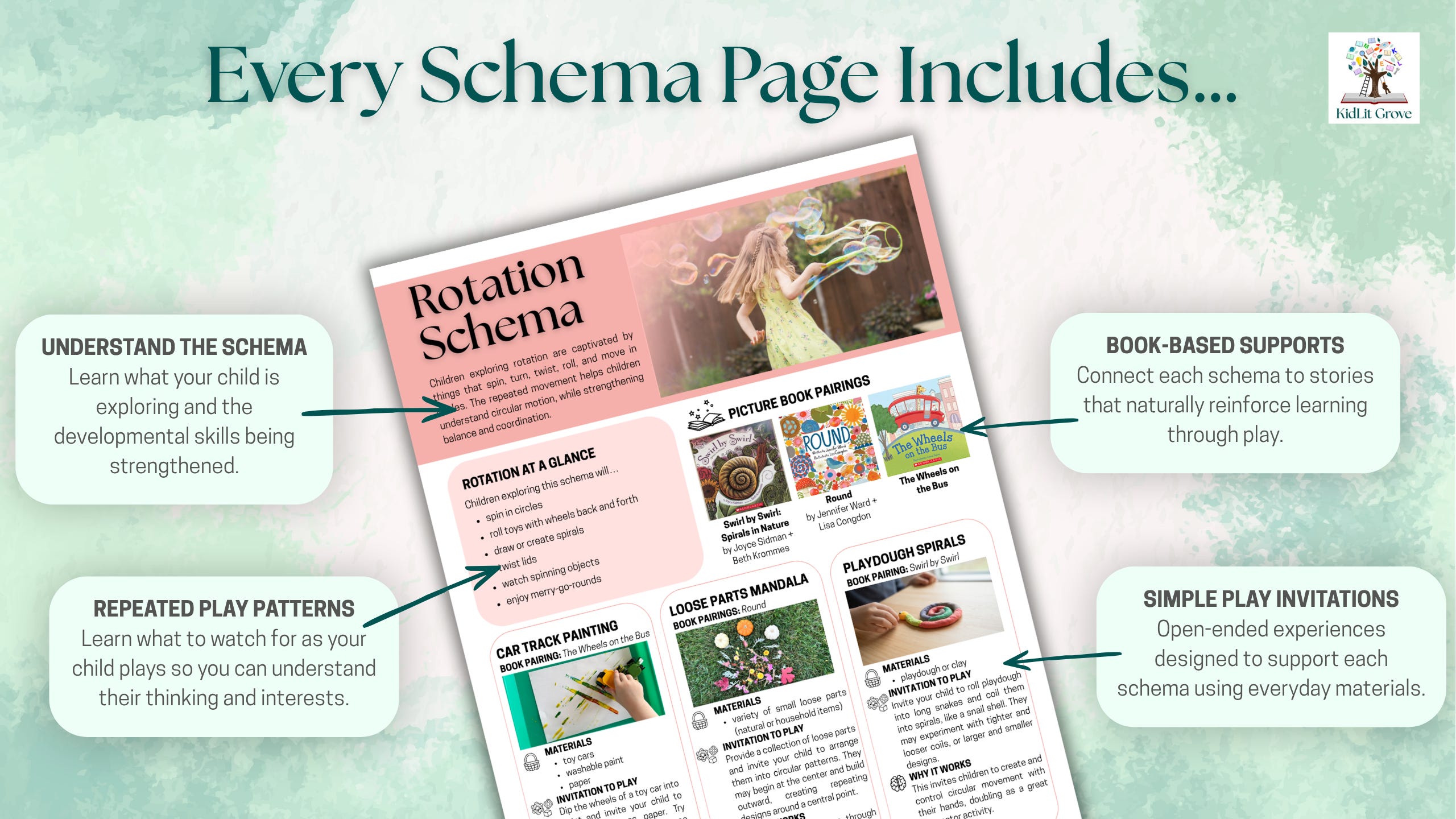
With each play schema, you’ll find:
Picture book pairings that reinforce the schema through story
An “At a Glance” guide to help you recognize common play behaviors
A simple overview explaining what children are exploring and the developmental concepts they’re building
Easy, playful invitations using everyday materials you likely already have
A brief note on why each invitation supports the schema, helping you understand the purpose behind the play
To be clear, this guide isn’t meant to give you more to do. Rather, I hope it helps you see what your child is already doing with fresh eyes.
Play is the work of the child.” - Maria Montessori
Play Schema Booklist
I’ve listed all of the picture books featured throughout the play schema series below. Each title was chosen because it naturally complements a particular play schema, making it easy to pair these stories with children's interests and extend their exploration through play.
You can also find these books listed in KidLit Grove’s Bookshop (affiliate link).
Books for Transporting Schema
Wheetle: A Little Wagon with a Big Heart by Cindy Derby
The Little Engine That Could by Watty Piper + Dan Santat
Trashy Town by Andrea Zimmerman + David Clemesha + Dan Yaccarino
Books for Containing Schema
Sanctuary: A Home for Rescued Farm Animals by Julia Denos
Forts by Katie Venit + Kenard Pak
What’s In Your Pocket? By Heather Montgomery + Maribel Lechuga
Books for Vertical Schema
Flower Block by Lenisha Butterfield + Huang Giang
Too Tall Houses by Gianna Marino
Treehouse Town by Gideon Sterer + Charlie Mylie
Books for Transforming Schema
Mix it Up! By Herve Tullet
So Much Slime by Jason Lefebvre + Zac Rets
Hamilton’s Hats by Martine Oborne + Axel Scheffler
Books for Connecting Schema
The Invisible String by Patrice Karst + Joanne Lew-Vreithoff
Boxitects by Kim Smith
Block City by Robert Louis Stevenson + Daniel Kirk
Books for Orientation Schema
Skywatcher by Jamie Hogan
This Book is Upside Down by Erin Rose Wage + Simona Ceccarelli
They All Saw a Cat by Brenden Wenzel
Books for Rotation Schema
Swirl by Swirl: Spirals in Nature by Joyce Sidman + Beth Krommes
Round by Jennifer Ward + Lisa Congdon
The Wheels on the Bus
Books for Enveloping Schema
The Jolly Postman or Other People’s Letters by Janel + Allan Ahlberg
Extra Yarn by Mac Barnett + Jon Klassen
The Napping House by Audrey Wood + Don Wood
Books for Positioning Schema
Pattern Fish by Trudy Harris + Anne Canevari Green
Sort it Out! By Barbara Mariconda + Sherry Roger’s
Your Farm by Jon Klassen
Books for Trajectory Schema
Wind is a Dance by Debra Kempf Shumaker + Josee Bisaillon
Go, Dog, Go! By P.D. Eastman
Stuck by Oliver Jeffers
The Play Schemas Guide is linked at the bottom of this post.
If a paid subscription isn’t the right fit for you right now, the guide is also available for individual purchase in the KidLit Grove shop using the button below. Followers of my store and first-time buyers will automatically receive 10% off at checkout!
Thank you for following along throughout this series. I’ve loved exploring these ideas and sharing them with you!
Warmly,
Lindsay